
Grounds of Trademark Rectification in India
Overview of Trademark Rectification Process
Briefly explain about trademark registration first, trademark registration is an official process to register your intellectual property and get legal protection.
However, in some of the cases where a registered trademark has some errors or conflicts with existing trademark or unused from a long time period, to rectify all these, business owners need to apply online for trademark rectification.
Like Trademark Registration, Trademark rectification is also a formal process of correcting the incorrect or wrongly registered trademarks or removed from Register of Trademarks. Rectification process also ensures the trademark register remains valid and accurate.
Through this article, we explain all the major grounds of trademark rectification and their eligibility and other important things before applying for a rectification application.
What is Trademark Rectification?
Trademark rectification is the legal process for correction, cancellation, removal or amendment of an entry recorded in the trademark register. Any aggrieved person can request for rectification in the case of a trademark whether wrongly registered or continues to remain on the register without legal process as per the Trade Mark Act, 1999.
The main purpose of trademark rectification is to update and correct details of trademarks in the database that is maintained by the Registrar of Trademarks.
Trademark Rectification is applicable for:
-
Trademark Removal
-
Errors Correction
-
Cancellation of wrongly registered marks
-
Changes in Trademark Details
-
Deletion for unused trademarks
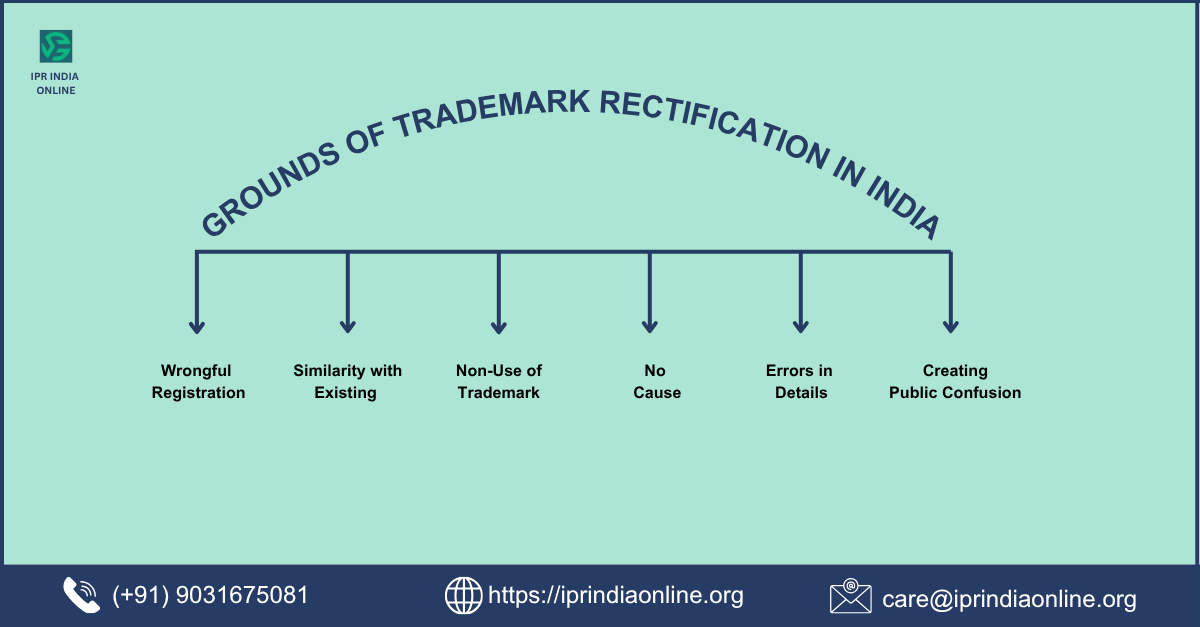
Grounds of Trademark Rectification
According to Indian trademark law, there are several legal grounds or reasons for trademark rectification. Major common grounds are following:
1. Incorrect or Wrongful Registration
One of the most common reasons for trademark rectification is wrongful or incorrect registration. If a trademark is registered by mistake or has incorrect details, a rectification application can be filed.
For example:
-
False claims of ownership
-
Submission of incorrect documents
-
False registration or fraud
-
Facts misrepresentation
If the registered trademark violates the legal norms, the trademark will be removed or need to be corrected.
2. Similarity with an Existing Trademark
A trademark needs to be rectified if it has similarity or identical with the existing registered trademark.
These situation lead to following confusion:
-
Confusing of brand name
-
Confusing the customer
-
Damaging the market reputation
3. Non-Use of Trademark
If the owner is not using the trademark continuously for a period of five years and three months from registration date, any aggrieved person may request for removal.
The trademark law does not encourage the non-use of trademarks and ensures that only actively used trademarks are only protected.
These situations arises in following conditions:
-
Business Shut Down
-
Brand Abandoned by Trademark owner
-
Registered without genuine commercial purpose
4. Registered Trademark Without Sufficient Cause
A trademark also needs to be rectified if it was registered without proper legal norms.
These situations arises in following conditions:
-
Mark is not distinguished
-
Mark is generic or common
-
Mark is description of goods or services
-
Refused by trademark law
If the trademark registration violates absolute (not unique) or relative grounds (similar with existing TM), rectification required.
5. Errors or Defects in Trademark Registration
In the case of clerical or typing mistakes or incorrect entries, the trademark needs rectification.
These situations arises in following conditions:
-
Wrong details of proprietor
-
Wrong address
-
Wrong classification of goods or services
-
Typographical errors
-
Mistakes in trademark details
In above mentioned cases, trademark owners can use the rectification process to fix these errors.
6. Trademark Create Public Confusion
A registered trademark that misleads or creates confusion in the market or among consumers, can be challenged through rectification.
These situations arises in following conditions:
-
The mark represents the product quality
-
Showing false association with another brand
-
Contains misleading elements
-
More chances of misunderstand by consumer about origin of goods or services
In this case, the Trademark Registry can order for cancellation or modification of such marks.
Who Can Apply for Trademark Rectification?
Any “affected or aggrieved person” can apply for trademark rectification. Following can be apply for rectification:
-
Trademark owners
-
Affected Businesses due to conflicting trademark
-
Prior user of a trademark
-
Companies who facing brand confusion
-
Deceptive trademarks
Important Point: A registered owner can also apply for trademark rectification to fix mistakes or update their trademark details.
Importance of Trademark Rectification
To protect intellectual property rights and to maintain fair market competition, trademark rectification plays an important role.
The main benefits of trademark rectification are:
Rectify Mistakes
Correct the typing errors, wrong descriptions, or errors that made during the process of registering a trademark.
Ownership Updates
Changes in TM such as new address or company names or transfer of the brand name.
Stop Competitors
Cancels the confusing similar marks that other competitors registered to create confusion.
Remove Unused Marks
Removes the unused or abandoned trademarks that also block new trademark applications.
Legal Protection Support
Official records are often required to win brand conflicts in court.
Note: Apply online for different types of intellectual property rights from our private IPR Registration portal.
Conclusion
For businesses or startups or trademark owners, understanding the grounds of trademark rectification is essential. If a trademark is wrongly registered or unused or confusing or deceptive , the Trade Mark Act, 1999 provides a rectification process.
Businesses must monitor their trademarks on a regular basis and take legal action whenever necessary. If they find that a trademark has been wrongly registered or creating conflicts with your rights, they can apply for trademark rectification through yourself and take help of IPR professionals for an error-free and hassle-free process.
With proper trademark management, businesses not only protect brand identity but also boost long-term business value.

 English
 Arabic
 French
 Spanish
 Portuguese
 Deutsch
 Turkish
 Italiano
 Russian
 Romaian
 Portuguese (Brazil)
 Greek
Greek