Why Your Phone is Basically a Slot Machine: The Neuroscience of Habit
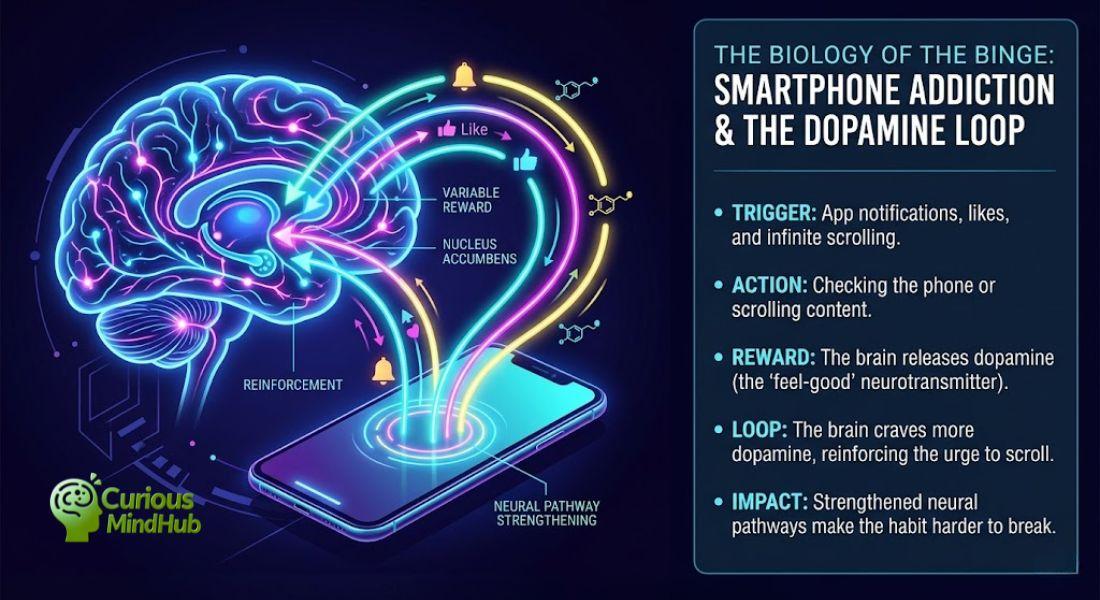
We’ve all been there, right? You grab your phone just to check a single text, and then—poof. Forty minutes are gone, vanished into a hazy blur of random videos and news updates you didn't even want to see. It’s easy to beat yourself up and say you just don't have enough willpower. But honestly? It’s not your fault. When you actually look at the neuroscience of habit, you realize your brain is essentially being outplayed by some of the smartest software engineers on the planet.
At Curious Mind Hub, we’re obsessed with the idea that once you see the "gears" turning in your own head, you can start taking back control. It’s not about going "anti-tech." It’s about realizing how these apps are playing your ancient biological wiring like a fiddle.
The Real Deal on Dopamine Loops
Most people talk about dopamine like it’s this "pleasure hit" you get after a job well done. But neurobiologists see it differently. Dopamine isn't the reward—it’s the "itch." It’s the neurochemistry of anticipation. It’s that restless, nagging feeling that drives you to keep looking for something... anything.
Think about social media addiction. You aren't necessarily having a blast every second you're on the app. In fact, you’re probably bored half the time. But you stay stuck in a loop of "maybe the next post will be the winner." That "maybe" is exactly what keeps the dopamine firing. It’s the hunt, not the find, that keeps your thumb moving.
Why "Infinite Scroll" is a Trap
Ever wonder why you can scroll forever without a natural "stop" sign? That’s the neurobiology of infinite scrolling in action. Tech designers borrowed a trick from Vegas called a variable reward schedule.
It’s the same logic as a slot machine. If a machine paid out every single time you pulled the lever, you’d get bored and walk away. But because it only pays out randomly, your brain stays locked in a state of high alert. You scroll past three dull posts, hit one funny meme, and suddenly your brain is convinced that the next big win is just one more swipe away. This unpredictability makes a scrolling addiction feel almost impossible to break by sheer force of will.
How This Constant Buzz Affects You
Living in a state of digital overstimulation isn't free. There’s a hidden cost to your cognitive health:
-
The Attention Shrink: Your brain gets used to these 15-second "payoffs." When you try to sit down and read a book or focus on a real project, it feels agonizingly slow. Your brain starts screaming for a distraction.
-
Mental Brain Fog: Ever notice how you can’t even remember what you looked at twenty minutes ago? That’s because you’re consuming "digital junk food." It fills up your time, but it leaves you feeling totally empty.
-
The Switching Tax: Every time you toggle between work and a notification, you’re paying a "tax" on your focus. It takes way more energy to get back into the "flow" than most people realize.
Rewiring Your Brain for Better Focus
The good news? Your brain is remarkably "plastic." It can change, adapt, and heal. Rewiring your brain for better focus isn't about some massive, dramatic life overhaul. It’s about adding "friction" back into your life.
-
Kill the Colors: Try putting your phone in Greyscale mode. It sounds weird, but when Instagram looks like a dusty 1940s newspaper, it loses that "candy-like" pull on your brain’s reward center.
-
The "Ten-Minute" Rule: When you feel that twitch to check your phone, don't tell yourself "no." Just say "not yet." Give it ten minutes. Usually, the dopamine spike settles down before the timer even goes off.
-
Create Distance: Proximity is everything. If your phone is in your pocket, you’re using mental energy just to not check it. Put it in another room. Let your brain breathe.
Why Digital Minimalism for Mental Health is the New Essential
Practicing digital minimalism for mental health isn't a trend—it’s a survival strategy. It’s about being intentional. It’s the difference between using a tool to get a job done and letting that tool use you to drive up its stock price.
If you’re looking for actual, workable ways to reduce social media screen time, start small. Don’t try to go "cold turkey" on day one. Maybe just make the first hour of your morning a phone-free zone. Give your nervous system a chance to wake up before the rest of the world starts demanding your attention.
Taking the Wheel Back
Look, breaking these cycles is a process. It’s not a straight line. You’ll have days where you fall back into a how dopamine loops affect the brain spiral. That’s okay. The goal is to move from being a passive passenger to the person actually driving the car.
The Bottom Line
Your attention is literally the most valuable thing you own. Learning how to protect it is the ultimate life hack. For more deep dives into how your mind works and how to keep it sharp, check out Curious Mind Hub. We’re all about helping you understand the "why" behind your "how." Thanks for being part of the Curious Mind Hub family.
FAQs
Is this a real "addiction"?
While the term social media addiction gets thrown around a lot, for many people, it’s a deep-seated habit built on persuasive design. It’s not always a clinical diagnosis, but if it’s making you feel like a zombie, it’s worth taking seriously.
How do I deal with the FOMO?
The "Fear of Missing Out" is just another dopamine trick. Once you actually step away for a few days, you usually realize you weren't "missing" anything vital—you were just missing the noise.
Can I really get my focus back?
Yes. Your brain is a master at recalibrating. If you cut back on the high-intensity digital hits, you’ll find that "slow" things—like a real conversation or a walk—start to feel rewarding again.

 English
 Arabic
 French
 Spanish
 Portuguese
 Deutsch
 Turkish
 Dutch
Dutch
 Italiano
 Russian
 Portuguese (Brazil)
 Greek
Greek