Aluminium has become one of the most important materials in modern manufacturing due to its lightweight structure, corrosion resistance, and high strength-to-weight ratio. However, when it comes to joining aluminium efficiently at scale, engineers often face one critical question: how to successfully spot weld aluminium?
Spot welding aluminium is possible but it is significantly more complex than welding steel. It requires precise control of current, force, and time, along with advanced resistance welding equipment and optimized process parameters.
In this guide, we will explore the fundamentals of aluminium spot welding, its technical challenges, industrial applications, and best practices for achieving consistent, high-quality welds in production environments.
Can You Spot Weld Aluminium?
Yes, aluminium can be spot welded using resistance welding technology, but it requires specialized systems designed for its unique physical and electrical properties.
Unlike steel, aluminium has:
- Very high electrical conductivity
- Low melting point
- Strong oxide layer (Al₂O₃) that resists electrical current
- High thermal conductivity, which dissipates heat quickly
These characteristics make aluminium more difficult to heat at the weld interface, meaning standard steel welding parameters will not work effectively.
Successful aluminium spot welding depends on:
- High-performance power delivery (high current, short duration)
- Strong electrode force control
- Clean surface preparation
- Advanced welding control systems
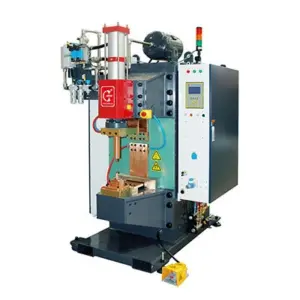
This is where industrial-grade systems from Heron Welder become essential for production stability and repeatability.
Key Challenges in Spot Welding Aluminium
Manufacturing engineers and production teams must overcome several technical challenges when spot welding aluminium:
1. Oxide Layer Barrier
Aluminium naturally forms a hard oxide layer that:
- Prevents stable electrical contact
- Increases contact resistance variability
- Leads to inconsistent nugget formation
Without proper cleaning or electrode penetration force, weld quality becomes unpredictable.
2. High Electrical Conductivity
Aluminium conducts electricity extremely well, which means:
- Current spreads quickly away from the weld zone
- Heat generation becomes harder to concentrate
- Requires significantly higher current than steel welding
3. Heat Dissipation
Due to high thermal conductivity:
- Heat is rapidly transferred away from the weld zone
- Short welding cycles must be precisely controlled
- Insufficient heat leads to weak weld nuggets
4. Electrode Wear
Aluminium tends to:
- Stick to electrodes
- Accelerate electrode degradation
- Require frequent dressing or replacement
5. Expulsion Risk
If parameters are not optimized:
- Molten aluminium can be ejected from the weld zone
- Leads to inconsistent weld strength and surface defects
Principle of Spot Welding Aluminium
Spot welding aluminium is a form of resistance welding where heat is generated through electrical resistance at the interface of overlapping sheets.
The basic principle includes three stages:
Stage 1: Clamping Force Application
Electrodes apply mechanical pressure to hold the aluminium sheets together. This ensures contact stability and reduces surface resistance variations.
Stage 2: Current Flow and Heat Generation
A high electrical current is passed through the electrodes. Heat is generated at the interface due to resistance, causing local melting.
Stage 3: Nugget Formation and Solidification
Once current is stopped, pressure is maintained while the molten metal cools and forms a solid weld nugget.
The quality of the weld depends on controlling:
- Current intensity
- Weld time
- Electrode force
- Cooling time
For aluminium, this process must be extremely precise due to its narrow process window.
Key Process Parameters for Aluminium Spot Welding
Achieving consistent aluminium welds requires strict control of multiple parameters.
1. Welding Current
- Much higher than steel welding
- Short pulse duration is preferred
- Must be stable and precisely controlled
2. Weld Time
- Extremely short cycle times
- Prevents excessive heat diffusion
- Reduces risk of expulsion
3. Electrode Force
- Higher force helps break oxide layer
- Stabilizes electrical contact
- Improves nugget formation consistency
4. Electrode Material and Shape
- Copper alloys are commonly used
- Water-cooled electrodes are preferred
- Proper tip geometry ensures stable current density
5. Surface Preparation
- Degreasing and cleaning improves consistency
- Removing oxide layers enhances conductivity
- Automation-friendly pre-treatment improves repeatability
Equipment Requirements for Aluminium Spot Welding
Not all resistance welding systems are suitable for aluminium. Industrial production requires advanced technology such as:
MFDC Resistance Welding Systems
Medium Frequency Direct Current (MFDC) systems provide:
- Stable output current
- Better energy efficiency
- Improved control over heat input
- Reduced transformer size and losses
Capacitor Discharge Welding Systems
These systems deliver:
- Extremely fast energy release
- Ideal for thin aluminium sheets
- Minimal heat-affected zone
Servo-Controlled Welding Guns
Servo guns allow:
- Precise force adjustment
- Programmable pressure profiles
- High repeatability in automation lines
Advanced Welding Controllers
Modern controllers provide:
- Real-time current feedback
- Adaptive welding control
- Defect detection capabilities
- Data logging for quality assurance
Industrial manufacturers like Heron Welder integrate these technologies into automated production lines to ensure consistent aluminium weld quality in high-volume manufacturing.
Applications of Aluminium Spot Welding
Aluminium spot welding is widely used across high-performance industries:
1. Automotive Industry
- EV battery enclosures
- Lightweight body structures
- Crash-resistant panels
2. Aerospace Manufacturing
- Aircraft fuselage panels
- Interior structural components
- Lightweight assemblies
3. HVAC and Cooling Systems
- Aluminium heat exchangers
- Compressor housings
- Lightweight duct systems
4. Electronics and Battery Systems
- Busbars and connectors
- Battery module assembly
- Power distribution systems
5. Industrial Equipment
- Machine housings
- Transport systems
- Lightweight structural frames
Best Practices for Spot Welding Aluminium
To ensure strong, reliable welds in production environments, engineers should follow these best practices:
Maintain Strict Surface Cleanliness
Even minor contamination can significantly affect weld quality.
Use High-Frequency Controlled Welding Systems
MFDC or capacitor discharge systems are highly recommended for aluminium applications.
Optimize Electrode Maintenance
Regular dressing and cooling prevent sticking and maintain stable weld quality.
Implement Process Monitoring
Use real-time feedback systems to detect:
- Weld inconsistency
- Current fluctuations
- Electrode wear
Conduct Regular Destructive Testing
- Peel tests
- Tensile strength tests
- Cross-sectional analysis
These help validate weld integrity in mass production.
Common Defects and Troubleshooting
1. Weak Weld Nuggets
Cause:
- Insufficient current or time
Solution:
- Increase energy input or improve electrode pressure
2. Excessive Expulsion
Cause:
- Overheating or excessive current
Solution:
- Reduce weld time or adjust force profile
3. Electrode Sticking
Cause:
- Poor surface condition or overheating
Solution:
- Improve cooling and electrode material selection
4. Inconsistent Weld Quality
Cause:
- Oxide layer variation or unstable power supply
Solution:
- Improve cleaning process and use advanced controllers
FAQs: Spot Weld Aluminium
1. Why is aluminium harder to spot weld than steel?
Because aluminium has high conductivity and a strong oxide layer, making heat generation and current concentration more difficult.
2. What type of welding system is best for aluminium?
MFDC resistance welding systems and capacitor discharge welding systems are most effective for aluminium applications.
3. Can aluminium be spot welded in high-volume production?
Yes, with proper automation, process control, and advanced equipment, aluminium spot welding is widely used in mass production industries.
4. How can weld quality be improved?
By optimizing current, electrode force, surface cleaning, and using real-time welding control systems.
5. What industries rely most on aluminium spot welding?
Automotive, aerospace, HVAC, electronics, and industrial manufacturing sectors.
Conclusion
Spot welding aluminium is a highly technical process that demands precision engineering, advanced control systems, and optimized production parameters. While challenging, it offers significant advantages in lightweight manufacturing, energy efficiency, and structural performance.
With the right technology and process expertise, manufacturers can achieve strong, repeatable aluminium welds suitable for even the most demanding applications.
For engineered resistance welding solutions, automation systems, and aluminium welding process optimization, Heron Welder provides customized industrial solutions designed to meet modern production challenges.
Contact Heron Welder today to request a quote or consult with our engineering team for tailored spot welding and automation solutions for aluminium applications.




 English
 Arabic
 French
 Spanish
 Portuguese
 Deutsch
 Turkish
 Dutch
Dutch
 Italiano
 Russian
 Portuguese (Brazil)
 Greek
Greek
