


Graphite Density: Meaning, Importance, and Applications
Graphite is one of the most important forms of carbon used in modern industries. From batteries and lubricants to aerospace and steel manufacturing, graphite plays a crucial role in many applications. One of the key physical properties that determines the performance of graphite is graphite density. Understanding graphite density helps manufacturers, engineers, and researchers choose the right graphite material for specific uses.
In this article, we will explain what graphite density is, how it is measured, the factors that influence it, and why it matters in different industries.
What is Graphite Density
Graphite density refers to the mass of graphite per unit volume, usually measured in grams per cubic centimeter (g/cm³). It indicates how tightly carbon atoms are packed within the graphite structure.
Graphite has a unique layered crystal structure where carbon atoms are arranged in hexagonal layers. These layers are strongly bonded internally but weakly connected between layers. This structure affects graphite's density and contributes to its excellent properties such as lubrication, conductivity, and heat resistance.
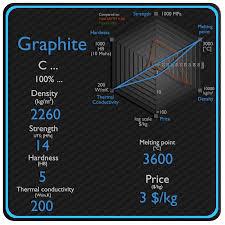
The theoretical density of pure graphite is approximately 2.26 g/cm³, but in practical applications, the density often ranges between 1.5 and 1.9 g/cm³ due to porosity and manufacturing processes.
Why Graphite Density is Important
Graphite density is a critical property that directly affects the mechanical strength, electrical conductivity, and durability of graphite materials.
Higher-density graphite usually provides:
-
Better mechanical strength
-
Improved electrical conductivity
-
Greater thermal conductivity
-
Increased resistance to wear and corrosion
Lower-density graphite, on the other hand, may contain more pores, making it lighter but sometimes less durable.
Because of these differences, manufacturers carefully control graphite density depending on the product’s intended use.
Types of Graphite and Their Density
Different types of graphite have different density ranges due to variations in their formation and processing.
Natural Graphite
Natural graphite is mined from the earth and comes in three main forms:
-
Flake Graphite
Density typically ranges between 2.1 – 2.23 g/cm³.
It is widely used in batteries, lubricants, and refractories. -
Amorphous Graphite
Density ranges from 1.9 – 2.2 g/cm³.
This type is commonly used in coatings and brake linings. -
Vein Graphite
One of the purest forms with density close to 2.23 g/cm³.
Synthetic Graphite
Synthetic graphite is manufactured from petroleum coke through high-temperature processing. Its density usually ranges between 1.6 – 1.9 g/cm³ depending on the manufacturing method.
Synthetic graphite is widely used in:
-
Lithium-ion batteries
-
Electrodes for steel production
-
Nuclear reactors
-
Aerospace components
Factors That Affect Graphite Density
Several factors influence the density of graphite materials.
1. Manufacturing Process
In synthetic graphite, the manufacturing process has a major impact on density. Steps like pressing, baking, and graphitization determine how tightly carbon particles bond together.
2. Porosity
Graphite naturally contains microscopic pores. Higher porosity means lower density because more empty space exists within the material.
3. Raw Material Quality
The purity and structure of the raw carbon materials used in graphite production can significantly affect the final density.
4. Temperature Treatment
Graphite processed at higher temperatures usually develops a more ordered crystal structure, which can slightly increase density and improve performance.
How Graphite Density is Measured
Graphite density is typically measured using the mass-to-volume ratio. The most common methods include:
Archimedes Method
This method measures density by calculating the weight difference of graphite in air and in liquid. It is commonly used for industrial graphite products.
Helium Pycnometry
This technique measures the true density by determining the volume of solid particles without considering pores.
Bulk Density Measurement
Bulk density measures the density of graphite powder or particles, including the spaces between them.
Each method is useful depending on whether manufacturers want to measure true density, apparent density, or bulk density.
Applications Where Graphite Density Matters
Graphite density plays a crucial role in determining the performance of graphite in different industries.
Lithium-Ion Batteries
Graphite is widely used as the anode material in lithium-ion batteries. Higher-density graphite allows more lithium ions to be stored, improving battery capacity and efficiency.
Steel Production
Graphite electrodes used in electric arc furnaces require high density and strength to withstand extreme temperatures and electrical currents.
Aerospace and Automotive Industries
Graphite components used in these industries must balance strength, weight, and thermal stability, making density an important design factor.
Lubricants and Coatings
Lower-density graphite is often used in lubricants because its layered structure allows easy sliding between surfaces.
Advantages of High-Density Graphite
High-density graphite materials offer several benefits:
-
Increased durability
-
Higher electrical conductivity
-
Better heat resistance
-
Improved mechanical strength
-
Longer product lifespan
Because of these advantages, high-density graphite is preferred in demanding industrial applications.
Frequently Asked Questions (FAQs)
What is the typical density of graphite?
The theoretical density of graphite is around 2.26 g/cm³, but commercial graphite materials typically range between 1.5 and 1.9 g/cm³.
Why does graphite density vary?
Graphite density varies because of porosity, manufacturing methods, and raw material quality.
Does higher graphite density mean better quality?
Not always, but in many industrial applications, higher density improves strength, conductivity, and durability.
How is graphite density measured?
Graphite density can be measured using methods such as the Archimedes method, helium pycnometry, and bulk density testing.
What industries rely on graphite density?
Industries like battery manufacturing, steel production, aerospace, automotive, and electronics rely heavily on graphite density for optimal performance.
Conclusion
Graphite density is a key physical property that influences the performance and reliability of graphite materials in many industries. It determines how compact the carbon structure is and directly affects important characteristics such as strength, conductivity, and thermal resistance.
From lithium-ion batteries to steel production and advanced engineering applications, understanding graphite density helps manufacturers select the right graphite material for specific needs. By controlling factors like porosity, processing temperature, and raw material quality, industries can produce graphite with the ideal density for high-performance applications.
As technology continues to evolve, the demand for optimized graphite materials will continue to grow. Therefore, a deeper understanding of graphite density will remain essential for improving efficiency, durability, and innovation across multiple industries.

 English
 Arabic
 French
 Spanish
 Portuguese
 Deutsch
 Dutch
Dutch
 Italiano
 Russian
 Romaian
 Portuguese (Brazil)
 Greek
Greek