


Solving Axial Load Failures in 72 Angular Contact Bearings
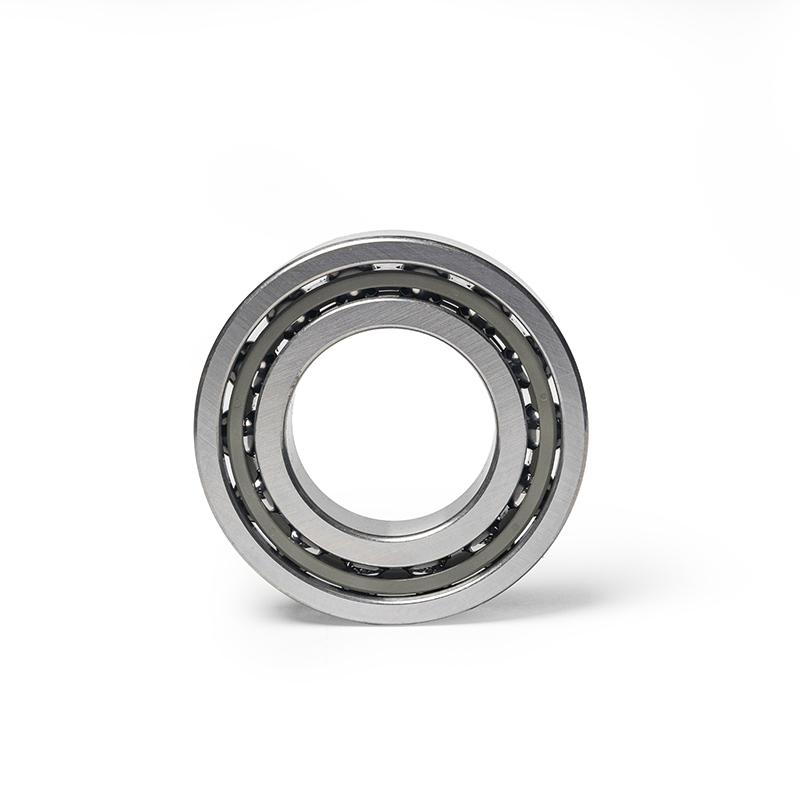
In industrial engineering, the 72 angular contact ball bearing is designed with a specific contact angle—typically $15^\circ$ (C), $25^\circ$ (AC), or $40^\circ$ (B)—that allows it to transmit combined loads diagonally through the balls to the raceways. Unlike standard deep-groove bearings, the 72 series is directional.
If your equipment is failing prematurely, it is rarely due to a manufacturing defect. Instead, the "problem" usually stems from the relationship between the bearing’s internal geometry and the external forces of your application.
1. The "False Brinelling" and Skidding Trap
A common issue in 72 series bearings, particularly in standby pumps or motors, is "skidding" damage.
-
The Problem: When a bearing is under-loaded (less than the minimum required axial load), the balls do not roll—they slide. This "skidding" creates microscopic smears on the raceway. When the pump finally ramps up to full speed, these smears act as friction points.
-
The Symptom: A rhythmic "growling" noise that increases with RPM.
-
The Solution: You must ensure a minimum axial load. If your system’s natural thrust is too low, you may need to increase the internal preload or use a wave spring to maintain constant pressure on the ball set.
2. Misalignment: The Silent Destroyer of the 72 Series
The 72 series has a larger ball diameter than the 70 series, which provides higher load capacity but makes it less tolerant of shaft deflection.
-
The Cause: If the shaft is misaligned by more than a few minutes of an arc, the contact angle fluctuates as the bearing rotates. This forces the balls to "climb" the shoulder of the raceway unequally.
-
The Result: Excessive heat at the "high point" of the rotation and eventual cage (retainer) fracture.
-
Expert Fix: Use laser alignment tools to ensure the housing and shaft are perfectly concentric. In applications where misalignment is unavoidable, consider a Face-to-Face (DF) mounting arrangement, which is more forgiving of angular errors than the rigid Back-to-Back (DB) setup.
3. Solving the "Heat Soak" in Duplex Pairs
Many 72 angular contact ball bearings are installed as "Universal" or "Matched Pairs." When these are mounted in a Back-to-Back (DB) configuration to handle high moment loads, heat dissipation becomes critical.
-
The Conflict: As the shaft heats up, it expands. In a DB arrangement, this expansion pushes the inner rings apart, which actually increases the internal preload.
-
The "Thermal Runaway": More preload leads to more friction, which leads to more heat, until the lubricant breaks down and the bearing seizes.
-
The Strategy: For high-heat environments (like steam pumps), specify a light preload or a "C3" internal clearance equivalent. Monitoring the temperature delta between the housing and the shaft can give you a 48-hour warning before a catastrophic seizure occurs.
4. Semantic Nuance: Choosing the Right Contact Angle ($\alpha$)
The performance of a 72 angular contact ball bearing is dictated by its suffix. Choosing the wrong one for your load profile is a recipe for disaster.
| Suffix | Angle | Advantage | Failure Risk if Misapplied |
| C | $15^\circ$ | Highest Speed | Low Axial Thrust Capacity |
| AC | $25^\circ$ | Balanced Load | Moderate Speed Limits |
| B | $40^\circ$ | Maximum Thrust | High Heat at High RPM |
If your pump generates 500kg of thrust but you’ve installed a $15^\circ$ (C) bearing, the balls will ride dangerously high on the shoulder. Always verify that your thrust requirements match the contact angle $(\alpha)$.
Maintenance Checklist for 72 Series Bearings
To stop the cycle of frequent replacements, audit these four areas:
-
Orientation: Is the "V" etched on the outer diameter pointing in the direction of the primary thrust?
-
Lubrication: Are you using an EP (Extreme Pressure) grease? The line contact in a 72 series under heavy load requires a higher film strength than a standard ball bearing.
-
Housing Fit: Ensure the outer ring is not "pinched" by the housing cover. An over-tightened end cap can inadvertently add several hundred pounds of preload.
-
Vibration Analysis: Look for peaks at the Ball Pass Frequency (BPFO/BPFI). Early detection of these frequencies can prevent a total shaft replacement.
Conclusion
The 72 angular contact ball bearing is a robust precision tool, but it is not "set and forget." Solving its failure points requires a holistic view of the system—from the alignment of the shaft to the thermal expansion of the housing. By matching your contact angle to your thrust loads and mastering the nuances of duplex preloading, you can transform a "problem joint" into a high-reliability asset.

 English
 Arabic
 French
 Spanish
 Portuguese
 Deutsch
 Turkish
 Dutch
Dutch
 Russian
 Romaian
 Portuguese (Brazil)
 Greek
Greek