


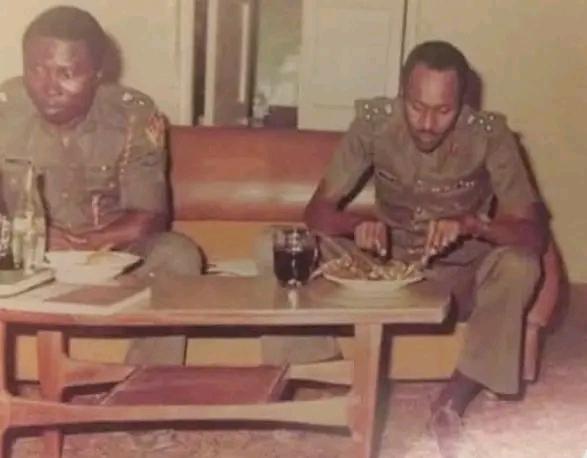
A photo captures Lt. Colonel Chris Ugokwe (left) and Brigadier Muhammadu Buhari sharing a meal with a chilled bottle of Coca-Cola sometime in the early 1980s. The relaxed moment reflects a bond rooted in their long military service, years of shared discipline, and the camaraderie that defined officers of their generation.
Both men joined the Nigerian Army in the early 1960s. Ugokwe would later recount that he enlisted on the exact same day as Muhammadu Buhari and Shehu Musa Yar’Adua, a coincidence that tied their careers together from the very beginning.
Ugokwe’s service took a dramatic turn after the July 1966 “reprisal coup.” Although he was officially placed on army leave, the atmosphere in the North had become dangerous for officers of Eastern Nigerian origin. His safety—and ultimately his survival—was secured through the intervention of Lt. Colonel Hassan Usman Katsina, the then governor of the Northern Region, under whom Ugokwe served as aide-de-camp.
In September 1966, as tensions escalated and the situation deteriorated further, Katsina personally ensured Ugokwe’s escape from the North. He was discreetly escorted to safety, marking the end of a perilous chapter and the beginning of his withdrawal from an army he had joined alongside some of Nigeria’s most consequential military figures.
Both men joined the Nigerian Army in the early 1960s. Ugokwe would later recount that he enlisted on the exact same day as Muhammadu Buhari and Shehu Musa Yar’Adua, a coincidence that tied their careers together from the very beginning.
Ugokwe’s service took a dramatic turn after the July 1966 “reprisal coup.” Although he was officially placed on army leave, the atmosphere in the North had become dangerous for officers of Eastern Nigerian origin. His safety—and ultimately his survival—was secured through the intervention of Lt. Colonel Hassan Usman Katsina, the then governor of the Northern Region, under whom Ugokwe served as aide-de-camp.
In September 1966, as tensions escalated and the situation deteriorated further, Katsina personally ensured Ugokwe’s escape from the North. He was discreetly escorted to safety, marking the end of a perilous chapter and the beginning of his withdrawal from an army he had joined alongside some of Nigeria’s most consequential military figures.
A photo captures Lt. Colonel Chris Ugokwe (left) and Brigadier Muhammadu Buhari sharing a meal with a chilled bottle of Coca-Cola sometime in the early 1980s. The relaxed moment reflects a bond rooted in their long military service, years of shared discipline, and the camaraderie that defined officers of their generation.
Both men joined the Nigerian Army in the early 1960s. Ugokwe would later recount that he enlisted on the exact same day as Muhammadu Buhari and Shehu Musa Yar’Adua, a coincidence that tied their careers together from the very beginning.
Ugokwe’s service took a dramatic turn after the July 1966 “reprisal coup.” Although he was officially placed on army leave, the atmosphere in the North had become dangerous for officers of Eastern Nigerian origin. His safety—and ultimately his survival—was secured through the intervention of Lt. Colonel Hassan Usman Katsina, the then governor of the Northern Region, under whom Ugokwe served as aide-de-camp.
In September 1966, as tensions escalated and the situation deteriorated further, Katsina personally ensured Ugokwe’s escape from the North. He was discreetly escorted to safety, marking the end of a perilous chapter and the beginning of his withdrawal from an army he had joined alongside some of Nigeria’s most consequential military figures.
0 Comments
·0 Shares
·540 Views
·0 Reviews