



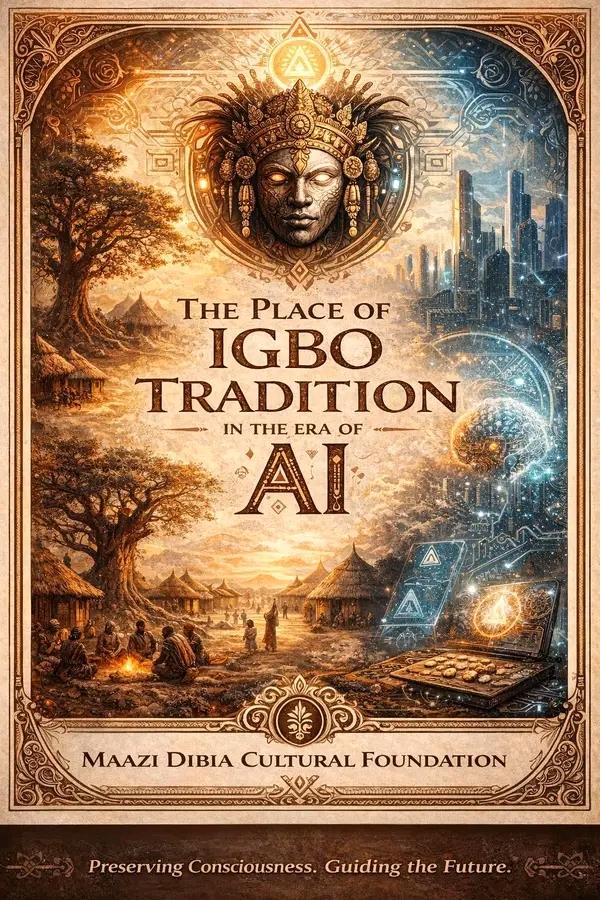
THE PLACE OF IGBO TRADITION IN THE ERA OF AI
The rise of Artificial Intelligence does not erase indigenous knowledge.
It exposes the urgency of remembering it.
We are entering an age where machines can simulate thought —
but they cannot inherit spirit.
Igbo tradition is not primitive memory.
It is a living epistemology.
1. Knowledge Systems: Data vs. Wisdom
AI processes data.
Igbo tradition processes meaning.
AI learns patterns.
A dibịa interprets destiny.
AI predicts behavior.
Afa reveals alignment.
The difference is not intelligence.
It is consciousness.
Igbo cosmology understands reality as layered:
Ụwa (visible world)
Ala mmụọ (spiritual plane)
Chi (personal destiny principle)
Agwụ (divine inspiration/conscious force)
AI operates only within measurable systems.
Igbo metaphysics includes the immeasurable.
2. Community vs. Algorithm
AI optimizes for efficiency.
Igbo society optimizes for balance.
The village model — council of elders, age grades, titled societies —
is decentralized intelligence.
Long before blockchain, Igbo governance functioned without a king in many regions.
Consensus was the algorithm.
3. Spiritual Technology
Western framing calls AI “technology.”
But what is divination?
Symbol processing
Pattern recognition
Probabilistic insight
Encoded knowledge transmission
Afa is an ancient cognitive technology.
The difference:
AI has no Chi.
A dibịa does.
4. Danger of Cultural Displacement
If Igbo youth embrace AI but abandon Ala,
they become technologically powerful but spiritually rootless.
A tree without roots cannot survive digital storms.
The danger is not AI.
The danger is amnesia.
5. The Future: Integration, Not Opposition
Igbo tradition does not fear innovation.
Historically, Igbo society adapted, traded, engineered, and evolved.
The question is not:
“Will AI replace tradition?”
The question is:
“Will tradition guide how we use AI?”
Imagine:
AI trained in Igbo language preservation
Digital archives of oral history
Smart systems documenting ritual knowledge (with sacred boundaries respected)
Cultural foundations using AI for global education
Technology becomes tool — not master.
6. The Philosophical Edge
AI simulates intelligence.
Igbo tradition investigates consciousness.
One calculates.
The other consecrates.
The era of AI demands not abandonment of tradition —
but deeper initiation into it.
Because the future will not be shaped by those who only code.
It will be shaped by those who understand both machine logic and metaphysical law.
"May we not loose ourselves 🙏🏿 in search of ourselves".
#maazidibia
Maazi_Dibia
The rise of Artificial Intelligence does not erase indigenous knowledge.
It exposes the urgency of remembering it.
We are entering an age where machines can simulate thought —
but they cannot inherit spirit.
Igbo tradition is not primitive memory.
It is a living epistemology.
1. Knowledge Systems: Data vs. Wisdom
AI processes data.
Igbo tradition processes meaning.
AI learns patterns.
A dibịa interprets destiny.
AI predicts behavior.
Afa reveals alignment.
The difference is not intelligence.
It is consciousness.
Igbo cosmology understands reality as layered:
Ụwa (visible world)
Ala mmụọ (spiritual plane)
Chi (personal destiny principle)
Agwụ (divine inspiration/conscious force)
AI operates only within measurable systems.
Igbo metaphysics includes the immeasurable.
2. Community vs. Algorithm
AI optimizes for efficiency.
Igbo society optimizes for balance.
The village model — council of elders, age grades, titled societies —
is decentralized intelligence.
Long before blockchain, Igbo governance functioned without a king in many regions.
Consensus was the algorithm.
3. Spiritual Technology
Western framing calls AI “technology.”
But what is divination?
Symbol processing
Pattern recognition
Probabilistic insight
Encoded knowledge transmission
Afa is an ancient cognitive technology.
The difference:
AI has no Chi.
A dibịa does.
4. Danger of Cultural Displacement
If Igbo youth embrace AI but abandon Ala,
they become technologically powerful but spiritually rootless.
A tree without roots cannot survive digital storms.
The danger is not AI.
The danger is amnesia.
5. The Future: Integration, Not Opposition
Igbo tradition does not fear innovation.
Historically, Igbo society adapted, traded, engineered, and evolved.
The question is not:
“Will AI replace tradition?”
The question is:
“Will tradition guide how we use AI?”
Imagine:
AI trained in Igbo language preservation
Digital archives of oral history
Smart systems documenting ritual knowledge (with sacred boundaries respected)
Cultural foundations using AI for global education
Technology becomes tool — not master.
6. The Philosophical Edge
AI simulates intelligence.
Igbo tradition investigates consciousness.
One calculates.
The other consecrates.
The era of AI demands not abandonment of tradition —
but deeper initiation into it.
Because the future will not be shaped by those who only code.
It will be shaped by those who understand both machine logic and metaphysical law.
"May we not loose ourselves 🙏🏿 in search of ourselves".
#maazidibia
Maazi_Dibia
THE PLACE OF IGBO TRADITION IN THE ERA OF AI
The rise of Artificial Intelligence does not erase indigenous knowledge.
It exposes the urgency of remembering it.
We are entering an age where machines can simulate thought —
but they cannot inherit spirit.
Igbo tradition is not primitive memory.
It is a living epistemology.
1. Knowledge Systems: Data vs. Wisdom
AI processes data.
Igbo tradition processes meaning.
AI learns patterns.
A dibịa interprets destiny.
AI predicts behavior.
Afa reveals alignment.
The difference is not intelligence.
It is consciousness.
Igbo cosmology understands reality as layered:
Ụwa (visible world)
Ala mmụọ (spiritual plane)
Chi (personal destiny principle)
Agwụ (divine inspiration/conscious force)
AI operates only within measurable systems.
Igbo metaphysics includes the immeasurable.
2. Community vs. Algorithm
AI optimizes for efficiency.
Igbo society optimizes for balance.
The village model — council of elders, age grades, titled societies —
is decentralized intelligence.
Long before blockchain, Igbo governance functioned without a king in many regions.
Consensus was the algorithm.
3. Spiritual Technology
Western framing calls AI “technology.”
But what is divination?
Symbol processing
Pattern recognition
Probabilistic insight
Encoded knowledge transmission
Afa is an ancient cognitive technology.
The difference:
AI has no Chi.
A dibịa does.
4. Danger of Cultural Displacement
If Igbo youth embrace AI but abandon Ala,
they become technologically powerful but spiritually rootless.
A tree without roots cannot survive digital storms.
The danger is not AI.
The danger is amnesia.
5. The Future: Integration, Not Opposition
Igbo tradition does not fear innovation.
Historically, Igbo society adapted, traded, engineered, and evolved.
The question is not:
“Will AI replace tradition?”
The question is:
“Will tradition guide how we use AI?”
Imagine:
AI trained in Igbo language preservation
Digital archives of oral history
Smart systems documenting ritual knowledge (with sacred boundaries respected)
Cultural foundations using AI for global education
Technology becomes tool — not master.
6. The Philosophical Edge
AI simulates intelligence.
Igbo tradition investigates consciousness.
One calculates.
The other consecrates.
The era of AI demands not abandonment of tradition —
but deeper initiation into it.
Because the future will not be shaped by those who only code.
It will be shaped by those who understand both machine logic and metaphysical law.
"May we not loose ourselves 🙏🏿 in search of ourselves".
#maazidibia
Maazi_Dibia
0 Comments
0 Shares
636 Views
0 Reviews

 Arabic
 French
 Spanish
 Portuguese
 Deutsch
 Turkish
 Dutch
Dutch
 Italiano
 Russian
 Romaian
 Portuguese (Brazil)
 Greek
Greek
