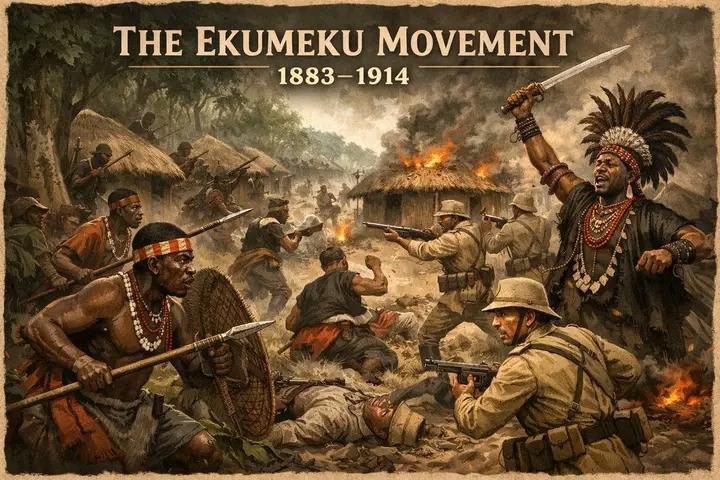
The Ekumeku Movement (1883–1914)
The Ekumeku Movement was a prolonged anti-colonial resistance in western Igboland against British expansion in the late 19th and early 20th centuries.
It is one of the longest organized armed resistances to British rule in what later became Nigeria.
#Where It Happened
The movement occurred mainly in present-day:
Asaba
Ogwuashi-Ukwu
Ibusa
Issele-Ukwu
These areas are inhabited by the Anioma Igbo (western Igbo).
What “Ekumeku” Means
“Ekumeku” referred to a secret, coordinated resistance network rather than a single army.
It operated like a guerrilla movement:
Surprise attacks
Night raids
Destruction of colonial installations
Strategic retreats
Leadership was decentralized, reflecting Igbo political structure.
Why It Started
In the 1880s–1890s, British commercial and political influence expanded inland through the Royal Niger Company.
The British attempted to:
Impose taxation
Control trade routes
Undermine traditional authority
Establish colonial courts
Western Igbo communities saw this as economic and political domination.
#Major Phases of the Conflict
1️⃣ Early Resistance (1883–1898)
Communities resisted foreign trade control and interference in local governance.
2️⃣ Intensified Warfare (1898–1906)
After Britain formally declared the Protectorate of Southern Nigeria, military campaigns increased.
British expeditions used:
Maxim guns
Organized regiments
Scorched-earth tactics
3️⃣ Final Suppression (1906–1914)
Villages were bombarded and leaders arrested or executed.
By 1914 (the year Nigeria was amalgamated), organized Ekumeku resistance had largely been crushed.
#Why This History Matters
The Ekumeku Movement shows:
Igbo resistance to colonialism was organized and sustained.
Western Igbo communities were politically coordinated despite lacking a centralized kingdom.
Colonial conquest in Igboland required repeated military campaigns, not peaceful treaties.
It also challenges the stereotype that Igbo societies did not conduct long-term unified resistance.
#Long-Term Impact
Many communities were economically weakened.
Colonial rule became firmly established.
Oral traditions in Anioma still preserve Ekumeku heroes.
Today, the term “Ekumeku” remains a symbol of Igbo resilience and resistance.
-- Bright Enyinnaya
The Ekumeku Movement (1883–1914)
The Ekumeku Movement was a prolonged anti-colonial resistance in western Igboland against British expansion in the late 19th and early 20th centuries.
It is one of the longest organized armed resistances to British rule in what later became Nigeria.
#Where It Happened
The movement occurred mainly in present-day:
Asaba
Ogwuashi-Ukwu
Ibusa
Issele-Ukwu
These areas are inhabited by the Anioma Igbo (western Igbo).
What “Ekumeku” Means
“Ekumeku” referred to a secret, coordinated resistance network rather than a single army.
It operated like a guerrilla movement:
Surprise attacks
Night raids
Destruction of colonial installations
Strategic retreats
Leadership was decentralized, reflecting Igbo political structure.
Why It Started
In the 1880s–1890s, British commercial and political influence expanded inland through the Royal Niger Company.
The British attempted to:
Impose taxation
Control trade routes
Undermine traditional authority
Establish colonial courts
Western Igbo communities saw this as economic and political domination.
#Major Phases of the Conflict
1️⃣ Early Resistance (1883–1898)
Communities resisted foreign trade control and interference in local governance.
2️⃣ Intensified Warfare (1898–1906)
After Britain formally declared the Protectorate of Southern Nigeria, military campaigns increased.
British expeditions used:
Maxim guns
Organized regiments
Scorched-earth tactics
3️⃣ Final Suppression (1906–1914)
Villages were bombarded and leaders arrested or executed.
By 1914 (the year Nigeria was amalgamated), organized Ekumeku resistance had largely been crushed.
#Why This History Matters
The Ekumeku Movement shows:
Igbo resistance to colonialism was organized and sustained.
Western Igbo communities were politically coordinated despite lacking a centralized kingdom.
Colonial conquest in Igboland required repeated military campaigns, not peaceful treaties.
It also challenges the stereotype that Igbo societies did not conduct long-term unified resistance.
#Long-Term Impact
Many communities were economically weakened.
Colonial rule became firmly established.
Oral traditions in Anioma still preserve Ekumeku heroes.
Today, the term “Ekumeku” remains a symbol of Igbo resilience and resistance.
-- Bright Enyinnaya ✍️






 English
 Arabic
 French
 Spanish
 Portuguese
 Deutsch
 Turkish
 Dutch
Dutch
 Russian
 Romaian
 Portuguese (Brazil)
 Greek
Greek