


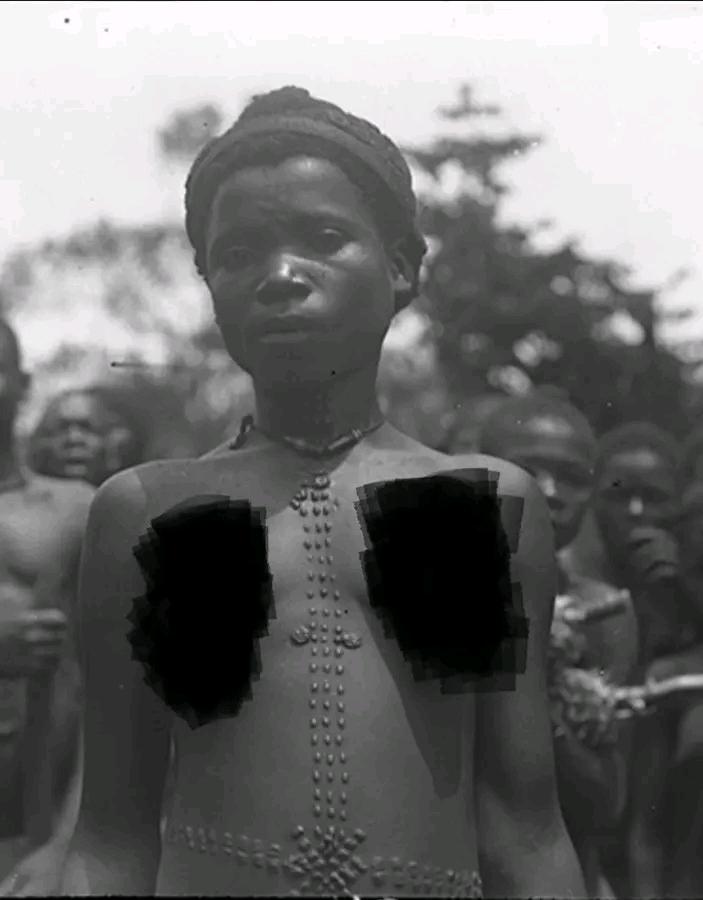
The practice of “”MBUBU””(body scarification) among the Igbos of Nigeria .
The practice of ichí and mbùbù scarification has deep roots in Igbo society, with oral traditions tracing its origins as far back as the 8th century AD, when early Igbo communities used body marks to signify identity, purity, honour, and adulthood. The ichí ritual begins with the arrival of the Nwádíọ́ká, the specialist from Umudioka who alone is permitted to perform the marks. He travels to meet the Nwá Ichí, the initiate, accompanied by two assistants. The first is Nwá Nsọ, who carries the specialist’s tool bag and prepares the mat and wooden headrest on which the initiate must lie. The second, Nwá Mgbádò Ichí, holds the initiate’s legs firmly to keep him still during the incisions.
Ichí markings are painful, and the initiate must show courage. To help him endure the ordeal, his mother or wife feeds him small pieces of fish from time to time, while relatives sing soothing but meaningful songs. These songs praise the art of ichí, the skill of the Nwádíọ́ká, and the honour gained by the initiate. After the cutting, Nwá Nsọ acts as a caregiver for fourteen days, washing the wounds with warm water and applying herbs that encourage healing.
Among the Igbo, mbùbù and nkí scarification patterns were worn by boys as signs of bravery and as an essential part of their initiation into manhood. For girls, they marked important transitions—coming-of-age rituals, fertility rites, public outings, and marriage ceremonies. A bride-to-be was expected to undergo mbùbù cicatrization before her marriage could be fully recognized. This process involved rough tattoo-like incisions across the front of the body, often arranged as a cross made with raised triple lines known as mbùbù or ebùbù. The presence of these cicatrices showed that a woman was married or preparing for marriage. To conceive before undergoing this ritual was considered a grave abomination in Igbo custom.
This tradition, captured in early photographs such as Northcote Thomas’s 1911 image of a woman with mbùbù marks, stands as one of the most enduring markers of identity, aesthetics, and social meaning in Igbo history.
#history
#viralphotochallenge
@black history
The practice of ichí and mbùbù scarification has deep roots in Igbo society, with oral traditions tracing its origins as far back as the 8th century AD, when early Igbo communities used body marks to signify identity, purity, honour, and adulthood. The ichí ritual begins with the arrival of the Nwádíọ́ká, the specialist from Umudioka who alone is permitted to perform the marks. He travels to meet the Nwá Ichí, the initiate, accompanied by two assistants. The first is Nwá Nsọ, who carries the specialist’s tool bag and prepares the mat and wooden headrest on which the initiate must lie. The second, Nwá Mgbádò Ichí, holds the initiate’s legs firmly to keep him still during the incisions.
Ichí markings are painful, and the initiate must show courage. To help him endure the ordeal, his mother or wife feeds him small pieces of fish from time to time, while relatives sing soothing but meaningful songs. These songs praise the art of ichí, the skill of the Nwádíọ́ká, and the honour gained by the initiate. After the cutting, Nwá Nsọ acts as a caregiver for fourteen days, washing the wounds with warm water and applying herbs that encourage healing.
Among the Igbo, mbùbù and nkí scarification patterns were worn by boys as signs of bravery and as an essential part of their initiation into manhood. For girls, they marked important transitions—coming-of-age rituals, fertility rites, public outings, and marriage ceremonies. A bride-to-be was expected to undergo mbùbù cicatrization before her marriage could be fully recognized. This process involved rough tattoo-like incisions across the front of the body, often arranged as a cross made with raised triple lines known as mbùbù or ebùbù. The presence of these cicatrices showed that a woman was married or preparing for marriage. To conceive before undergoing this ritual was considered a grave abomination in Igbo custom.
This tradition, captured in early photographs such as Northcote Thomas’s 1911 image of a woman with mbùbù marks, stands as one of the most enduring markers of identity, aesthetics, and social meaning in Igbo history.
#history
#viralphotochallenge
@black history
The practice of “”MBUBU””(body scarification) among the Igbos of Nigeria 🇳🇬.
The practice of ichí and mbùbù scarification has deep roots in Igbo society, with oral traditions tracing its origins as far back as the 8th century AD, when early Igbo communities used body marks to signify identity, purity, honour, and adulthood. The ichí ritual begins with the arrival of the Nwádíọ́ká, the specialist from Umudioka who alone is permitted to perform the marks. He travels to meet the Nwá Ichí, the initiate, accompanied by two assistants. The first is Nwá Nsọ, who carries the specialist’s tool bag and prepares the mat and wooden headrest on which the initiate must lie. The second, Nwá Mgbádò Ichí, holds the initiate’s legs firmly to keep him still during the incisions.
Ichí markings are painful, and the initiate must show courage. To help him endure the ordeal, his mother or wife feeds him small pieces of fish from time to time, while relatives sing soothing but meaningful songs. These songs praise the art of ichí, the skill of the Nwádíọ́ká, and the honour gained by the initiate. After the cutting, Nwá Nsọ acts as a caregiver for fourteen days, washing the wounds with warm water and applying herbs that encourage healing.
Among the Igbo, mbùbù and nkí scarification patterns were worn by boys as signs of bravery and as an essential part of their initiation into manhood. For girls, they marked important transitions—coming-of-age rituals, fertility rites, public outings, and marriage ceremonies. A bride-to-be was expected to undergo mbùbù cicatrization before her marriage could be fully recognized. This process involved rough tattoo-like incisions across the front of the body, often arranged as a cross made with raised triple lines known as mbùbù or ebùbù. The presence of these cicatrices showed that a woman was married or preparing for marriage. To conceive before undergoing this ritual was considered a grave abomination in Igbo custom.
This tradition, captured in early photographs such as Northcote Thomas’s 1911 image of a woman with mbùbù marks, stands as one of the most enduring markers of identity, aesthetics, and social meaning in Igbo history.
#history
#viralphotochallenge
@black history
0 Comments
·0 Shares
·778 Views
·0 Reviews